
Stretches for Bursitis in Hips
Most of the stretches for bursitis in hips that get recommended online make it worse. The figure-four, pulling the knee across the body, the IT band stretch, foam rolling the outer hip — all of them compress the exact structure that is already irritated, and they are a common reason hip bursitis pain persists for months.
Safer options keep the hip in neutral or slightly out to the side rather than crossing the midline, such as a half-kneeling hip flexor stretch, supine hamstring stretch, calf stretch, thoracic rotation, and standing quadriceps stretch.
That is not a reason to do nothing. It is a reason to stretch differently, and to put most of your effort into hip bursitis exercises that strengthen rather than lengthen.

If you are dealing with hip bursitis or greater trochanteric pain syndrome and want to know what will actually calm it down, this guide explains which stretches to avoid, which ones are usually safe, the exercises that help build hip strength, how load management and daily positions affect pain, and when it makes sense to get the hip assessed.
Getting this right matters because the wrong stretches can keep the bursa and tendons irritated, while the right combination of activity modification and strengthening can reduce pain and improve function over time.
Why Stretching Backfires
Trochanteric bursitis is the old name for pain over the bony point on the outer hip. Bursae are fluid filled sacs that reduce friction where tendon crosses bone, and the trochanteric bursa sits between the gluteal tendons and the greater trochanter.
Current understanding is that in most cases an inflamed bursa is not the primary problem — the tendons are. Gluteal tendinopathy is degeneration of the tendons attaching to that bony point, with the bursa irritated as a consequence. The umbrella term now used is greater trochanteric pain syndrome.
Hip bursitis occurs where load exceeds what the tendon can tolerate — repetitive movements, a sudden increase in walking, poor movement patterns that let the pelvis drop with each step, or a fall onto the side. Climbing stairs is the classic example of an activity that aggravates hip bursitis, because it increases demand on the gluteal tendons at the same time as compressing them. Walking uphill does the same.
That distinction matters, because it changes the hip bursitis treatment entirely. The mechanism is compression of tissue outside the hip joint, not tightness.
Every time the thigh crosses the midline of the body — adduction — the tendon and bursa are squeezed between the bone underneath and the iliotibial band above. Hold that position, or repeat it, and ongoing inflammation is the result, because the tissue never gets a chance to settle.
Now look at what a typical hip stretch asks you to do. Pull the knee across the chest. Cross one leg over the other and lean forward. Drop the hip out sideways against a wall. Every one of those puts the hip into adduction and clamps the sore structure harder.
A national health service explains what causes bursitis to develop and why it persists while the aggravating activity continues. Stretching into compression is that aggravating activity, done deliberately, twice a day — which is how certain exercises make hip bursitis worse rather than better.
Stretches That Aggravate Hip Bursitis to Stop
If you are doing any of these for outer hip pain, stop:
- Figure-four or piriformis stretch. Ankle across the opposite knee, pulling in. Deep adduction plus flexion — the worst combination for this tendon.
- Knee-across-body stretch. Lying on your back, pulling the knee over to the opposite side.
- Standing IT band stretch. Crossing one leg behind the other and leaning away. This is the classic, and on a painful hip it is the most reliably aggravating of the lot.
- Foam rolling the outer thigh. Rolling directly over the greater trochanter presses the inflamed tissue against bone with your body weight on top.
- Deep glute stretches in a squat position with the feet shoulder width apart and the knee pulled inward.
- Sleeping or resting in a “pigeon” position, which holds the hip in the same compressed shape for minutes at a time.
The common thread is not the muscle being stretched. It is where the thigh sits relative to the midline.
Stretches That Are Safe
Stretching is not banned. Anything that keeps the hip at or outside the midline is generally fine, and some of it is genuinely useful:
- Hip flexor stretch in half-kneeling, knees hip-width apart and the pelvis square. Tuck the tailbone under rather than arching the back, since tight hip flexors can worsen bursitis symptoms by altering posture, so the pelvis should stay tucked and neutral. The hip stays in neutral throughout.
- Supine hamstring stretch with a strap. Lie with knees bent and feet flat, then lift one leg straight upwards, knee straight, rather than pulling it across the body. Swap to the other leg.
- Calf stretch against a wall, standing evenly on both feet.
- Thoracic rotation, sitting or on all fours. Useful because stiffness higher up changes how you load the hip when you walk, and it is a standard inclusion in physical therapy programs for this condition.
- Standing quadriceps stretch, holding a stable surface for balance, knees kept together and level.
Two rules govern all of them. Keep the knee tracking forwards rather than crossing the midline, and keep both hips level rather than dropping one out to the side.
Hip Bursitis Exercises That Do Help
These are the best hip bursitis exercises to begin with — the same ones a physical therapist would usually start you on. Move through controlled movements, exercise slowly, and stop short of anything that spikes your pain level.
Isometric wall press. Stand side-on to a wall with the affected side nearest it, that knee bent to a right angle and the outside of the knee against the wall. Press the knee into the wall, hold for a few seconds to around thirty, then release. Weight stays even on the other leg throughout. This is usually the first of the trochanteric bursitis exercises to introduce, because it loads the tendon without moving through a painful range.
Clamshell. Lie on the unaffected leg with hips stacked and a pillow between the knees. Keep the feet together, then lift the top knee a few centimetres, hold briefly, and slowly lower to the starting position. This targets hip stabilizers such as gluteus medius for bursitis relief. The pelvis stays still rather than rolling backwards.
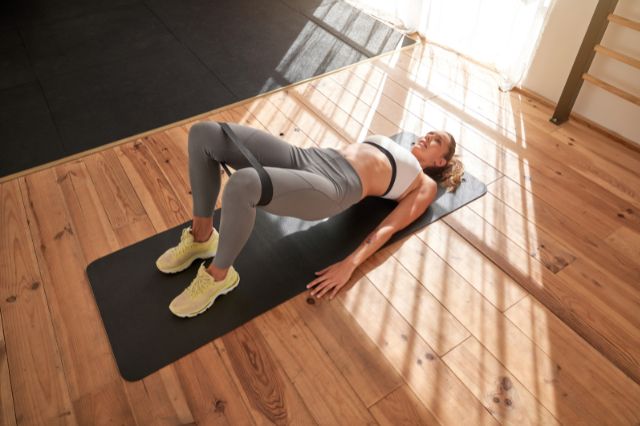
Bridge. Lie on your back, knees bent, feet flat and hip-width apart. Lift the hips until the trunk and thighs form a straight line, squeezing the butt muscles at the top, then lower under control. Keep the knees apart rather than letting them fall together. Engaging the pelvic floor and lower abdominals gently helps stabilise the trunk, and glute bridges strengthen glutes, reduce hip discomfort, and work the muscles surrounding the hip.
Standing abduction with a resistance band. With a band around the ankles, stand tall holding a stable surface, and take the affected leg out to the side, keeping the knee straight so the whole limb moves as one straight leg in line with the body. Control the return rather than letting it snap back. It is also one of the more effective ways to strengthen hip muscles for this condition.
Step-ups. Step onto a low step leading with the affected leg, keeping the pelvis level rather than dropping to one side. Keep the platform low, because high platforms compress and irritate the bursa. This is where the hip stabilizers actually get trained, and it matters more than anything done lying down.
Partial squats. Use a shallow range and sit back only slightly, stopping well before any hip compression or pain.
Single-leg balance. Stand on the affected hip side near a support for thirty seconds, hips level. Simple, unglamorous, and directly relevant to hip stability while walking.
A short walk beforehand to increase blood flow through the hip muscles and the other soft tissues surrounding the joint makes the first few repetitions more comfortable. Two to three sessions a week for the loaded work, with the isometric holds most days, is a reasonable exercise routine to start from.
Stretching Is Not the Treatment
Here is the part that matters most, and it is why this article cannot end with a list of stretches.
A degenerative tendon does not need lengthening. It needs load. The best exercises for this condition strengthen muscles progressively — isometric holds early, then loaded abduction, then single-leg weight-bearing work — combined with removing the compressive positions from your day. That is what produces lasting pain relief, rather than short-term relief that fades by the afternoon.
The evidence behind these exercises for hip bursitis, and how to progress them properly, is set out in what actually works for gluteal tendinopathy. If you read one thing after this page, read that one.
Stretching has a supporting role at best. Load management and strengthening do the work.
Positions to Fix First
Before any exercise program, the positions you hold for hours matter more than the ones you hold for thirty seconds:
- standing with your weight dropped onto one hip
- sitting with legs crossed, or knees together and feet apart
- sleeping on the sore side, or with the top leg falling across the body — use a pillow between the knees
- low, soft chairs that put the hip into deep flexion
- long walks on a cambered road or footpath, which holds one hip in adduction the whole way
For many people, changing these alone will relieve hip pain within a couple of weeks. It costs nothing and it is the highest-yield thing on this page. Reducing the compression is also what allows the body to reduce inflammation around the bursa on its own.
If the Pain Is at the Front
Everything above concerns pain on the outer side. Pain at the front of the hip and groin is a different problem and the advice reverses.
Irritation of the iliopsoas bursa, under the hip flexor tendon at the front, can respond to gentle hip flexor stretching rather than being aggravated by it. A tendon snapping over bone at the front produces a clunk and often needs no treatment at all. And groin pain with catching or clicking may be bone pinching at the edge of the joint rather than a bursa.
Which is why the location of your pain decides the plan. Outer hip and groin are not variations of the same thing.
When to Get It Looked At
Stretching the wrong structure for months is the most common reason people arrive having made no progress. Worth an assessment if:
- persistent pain that has not improved after three months of a proper loading program
- you cannot lie on the affected side at night, and it is not settling
- the pain is in the groin rather than the outer hip, which points more towards arthritis in the joint — the features that separate them are worth reading
- there is weakness rather than just hip discomfort, or a limp that has appeared
- you have had a fall or a sudden onset, which raises the possibility of a tear
Where imaging shows a significant tear and rehabilitation has failed, surgical repair of the gluteal tendons addresses the structural problem. That applies to a small minority. The hip conditions I assess each have their own page if your pattern does not fit what is described here.
Frequently Asked Questions (FAQs)
What stretches are good for hip bursitis?
Stretches that keep the hip in neutral — half-kneeling hip flexor stretch, supine hamstring stretch with the leg lifted straight up, calf stretch, thoracic rotation. Avoid anything that pulls the thigh across the midline, since that compresses the irritated tendon and bursa against the bone.
Should I stretch my IT band for hip bursitis?
No. The standing IT band stretch pulls the hip into adduction, which is the position that compresses the tendon and bursa. It is one of the most commonly recommended and most reliably aggravating stretches for this condition.
Is foam rolling good for hip bursitis?
Rolling directly over the bony point on the outer hip presses inflamed tissue against bone under body weight, and typically makes symptoms worse. Rolling the quadriceps or calves away from the sore area is unlikely to cause a problem.
Why does stretching make my hip pain worse?
Because the problem is compression rather than tightness. A tendon that is being squashed against bone does not improve by being squashed harder. If a stretch reproduces your pain, that is information rather than a sign you should push into it.
How should I sleep with hip bursitis?
On the non-painful side where possible, with a pillow between the knees so the top leg does not fall across the body. If you sleep on your back, a pillow under the knees can help. Lying directly on the sore hip compresses the tendon all night.
Can I still walk and exercise?
Yes, and you should. Reduce distance, avoid hills and cambered surfaces, and shorten your stride. Cycling with the seat high enough that the hips do not rock, and swimming avoiding breaststroke kick, are usually well tolerated.
How long does hip bursitis take to settle?
With a structured strengthening program, meaningful improvement usually takes three to six months. Progress is not linear and flare-ups are normal. Stopping once the pain settles is the most common reason it returns.
Does a cortisone injection help?
It can reduce pain for a period and make rehabilitation possible, particularly where sleep is badly disrupted. Used on its own the relief is usually temporary, and repeated injections may be unhelpful for tendon quality over time.
Discuss Your Hip
This information is general in nature and does not constitute medical advice. It is not a substitute for professional medical advice from your GP, physiotherapist or from orthopedic specialists who have examined you. Exercises and stretches should be selected and progressed based on your own examination findings, and anything that is not pain free at a manageable level should be reviewed before you continue.
To arrange an assessment, book online or call (02) 9437-9794. I consult at Wahroonga, St Leonards, Frenchs Forest, Gosford and Tamworth.
MTP Health offers exercise physiology in St Leonards to support patients through post-surgical rehabilitation.